The Nether is where Minecraft stops being forgiving. Lava seas, ghast fireballs and angry piglins can end a trip in seconds, and your gear is left behind in one of the most dangerous places in the game. With the right preparation, though, it is also where you find blaze rods, netherite and some of the best loot around. This guide covers how to prepare, survive each biome and what to hunt for on Bedrock Edition, the version on PS5.
Nether Survival at a Glance
| Topic | Key facts (Bedrock) |
|---|---|
| Portal | Obsidian frame from 4×5 up to 23×23; corners are optional, so 10 obsidian is enough |
| Travel distance | 1 block in the Nether equals 8 blocks in the Overworld |
| Height | 128 blocks, with bedrock floor and ceiling; lava seas at about Y 31 |
| Must-have item | At least one piece of gold armor to keep piglins neutral |
| Never do this | Sleep in a bed: it explodes |
| Respawning | Use a Respawn Anchor charged with glowstone |
| Top targets | Blaze rods, Nether Wart, Ancient Debris, Netherite Upgrade templates |
| Best Y level for Ancient Debris | Around Y 16 on Bedrock |
Before You Go: What to Pack
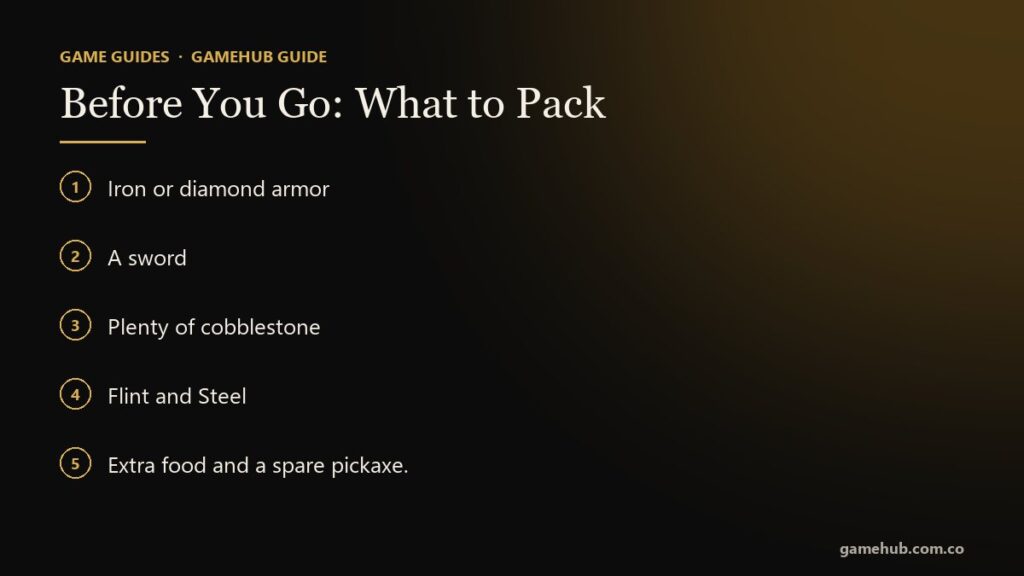
Keep the first trip short. If your world is only a few days old, start with our guide to surviving your first night and come back once you have iron gear and a stable base. For the Nether, pack:
- Iron or diamond armor, with one gold piece. Golden boots or a golden helmet is the usual choice.
- A sword, bow and arrows. Ghasts and blazes stay out of melee range, so a bow is essential.
- Plenty of cobblestone. Netherrack is easy to break, but ghast explosions destroy it easily. Cobblestone resists ghast fireballs much better, so use it for bridges and quick shelters.
- Flint and Steel. If a ghast fireball puts out your portal, you will need to relight it to get home.
- Extra food and a spare pickaxe.
- Gold ingots for bartering with piglins.
- Fire Resistance potions, if you have them. They make you immune to fire and lava damage for 3 minutes, or 8 minutes for the extended version.
Leave your most valuable items at home on the first visit. Dying in lava destroys most dropped items.
Building and Using a Nether Portal
A Nether portal is an obsidian frame at least 4 blocks wide and 5 blocks tall, measured on the outside, and up to 23×23. The corners do not need obsidian, so the smallest portal takes just 10 blocks. Light the inside with Flint and Steel or a fire charge. You can also find ruined portals in the Overworld, which often just need a few missing blocks replaced.
The 1:8 rule and linking portals
Every block you walk in the Nether covers 8 blocks in the Overworld. To link a Nether portal to a specific place in the Overworld, divide the Overworld X and Z coordinates by 8 and build the Nether portal there (Y stays the same). On Bedrock, the game searches for an existing portal within 128 blocks horizontally, in both the Overworld and the Nether, so portals that are too close together can link to the wrong one. That is why it pays to plan coordinates carefully.
On PS5 you will need coordinates on screen for this. Turn on Show Coordinates in your world settings before you leave. Write down your portal’s Nether coordinates as soon as you arrive, because compasses spin uselessly in the Nether unless linked to a lodestone, and Overworld maps show a randomly spinning marker there.
Core Survival Rules
Respect lava
Lava is the number one killer in the Nether. Lava seas sit at about Y 31, and lava falls and pockets are everywhere. Never dig straight down, and never dig straight up into the ceiling of a tunnel, because a pocket of lava can pour in. Bridge across lava instead of jumping gaps; a block placed ahead of you is always safer than a leap.
Do not sleep
Beds explode when you try to use them in the Nether, and the blast is strong enough to kill you. To set a spawn point in the Nether, use a Respawn Anchor instead. It is crafted from crying obsidian and glowstone and needs to be charged with glowstone blocks, using one charge each time you respawn.
Water does not work
Placing water from a bucket in the Nether just creates steam. You cannot use a water bucket to break a fall or put out a fire, so take extra care with heights.
The Five Nether Biomes

| Biome | Main threats | What it’s good for |
|---|---|---|
| Nether Wastes | Ghasts, magma cubes, zombified piglins, piglins | Nether quartz, Nether gold ore, glowstone, fortresses |
| Crimson Forest | Hoglins and piglins | Crimson wood, food from hoglins, bastions |
| Warped Forest | Endermen only | Warped wood and fungus; the safest biome to build in |
| Soul Sand Valley | Ghasts and skeletons | Soul sand, bone blocks, Dried Ghasts, fortresses |
| Basalt Deltas | Magma cubes and tricky terrain | Basalt, blackstone, magma cream |
Nether Wastes
The classic red Nether biome and the most common. Open spaces mean ghasts can see you from far away. Keep cobblestone handy to block fireballs and fight ghasts with a bow, or hit their fireballs back at them: a deflected fireball that strikes a ghast kills it instantly.
Crimson Forest
Hoglins are the main danger here. They are hostile, have 40 health (20 hearts) and hit hard. They will not come within 7 blocks of warped fungus, an active Nether portal or a Respawn Anchor, so holding a warped fungus in a flower pot near your path or base keeps them away. Killing them gives raw porkchops and occasionally leather.
Warped Forest
The only mobs that spawn here are endermen and striders, which makes it the calmest place to set up a base. Just avoid looking directly at endermen.
Soul Sand Valley
Soul sand slows you down, which makes dodging ghast fireballs and skeleton arrows harder. Soul Speed boots solve this. Since the Chase the Skies drop in 2025, Dried Ghasts also generate naturally here. Bring one home and place it in water and it will eventually become a ghastling, the baby form of the rideable Happy Ghast.
Basalt Deltas
Jagged terrain, falling ash and frequent magma cubes make this the most awkward biome to cross. Magma cubes split into smaller cubes when killed and drop magma cream, the ingredient for Fire Resistance potions. Bastion Remnants never generate here.
Dealing with Piglins
Piglins stay neutral as long as you wear at least one piece of gold armor. They will still turn on you if you open or break containers such as chests and barrels nearby, mine gold blocks or Nether gold ore near them, or attack any piglin. Once one is angry, nearby piglins join in.
Piglin brutes, found only in Bastion Remnants, are different: they attack on sight regardless of gold armor, have 50 health and carry golden axes. They never respawn, so clearing a bastion’s brutes is permanent.
Zombified piglins are neutral until you hit one, at which point the whole nearby group attacks. Avoid swinging at anything near them.
Bartering for supplies
Drop or give a gold ingot to an adult piglin and, after about 8 seconds on Bedrock (6 on Java), it throws back a random item. Possible results include Ender Pearls, string, obsidian, crying obsidian, Fire Resistance potions, Nether quartz, leather, iron nuggets and, rarely, Soul Speed books or boots. On Bedrock, if you anger a piglin mid-barter, it hands over its item immediately and then attacks.
What to Find in the Nether
Nether Fortresses
Fortresses are dark nether brick structures of long bridges and corridors. They hold the two things you must have to progress: blaze rods (from blazes) for brewing and Eyes of Ender, and Nether Wart for almost every potion. Look for Nether Wart growing on soul sand at the base of staircases inside the fortress. Blaze spawners sit on small fenced platforms reached by stairs.
Fortress mobs include blazes, wither skeletons, magma cubes, skeletons and zombified piglins. On Bedrock, mobs spawn in smaller groups than on Java, but they can spawn on any normal block inside the fortress, not just nether brick. Wither skeletons deserve special respect: their hits inflict Wither, which can kill. They stand about 2.4 blocks tall and cannot fit through a two-block-high gap, so a two-block tunnel makes a safe fallback. Each one has a 2.5% chance to drop a skull, plus 2% per level of Looting on Bedrock, and you need three skulls to summon the Wither boss.
Fortress chests can contain diamonds, saddles, golden horse armor and obsidian, so open every chest you pass.
Bastion Remnants
Bastions are huge blackstone fortresses full of piglins and brutes, found in every biome except Basalt Deltas. They are the most dangerous structures in the Nether, but also the richest. The treasure room always has a chest with a Netherite Upgrade smithing template, and Bedrock treasure chests have a good chance of holding a netherite ingot. Other bastion chests have a 10% chance of a template too. Remember that opening chests and breaking gold blocks inside will anger every piglin nearby, so clear or wall off the area first.
Bastion chests also hold Soul Speed books and boots, and Pigstep, a music disc found only there.
Ancient Debris and Netherite
Ancient Debris is the source of netherite, the best gear material in the game. On Bedrock it generates between Y 8 and Y 119, with most of it between Y 8 and Y 23. Y 16 has the most on average, so strip-mining in long tunnels around that height is the standard approach. You need a diamond or netherite pickaxe to mine it.
Each block smelts into one Netherite Scrap. Four scrap and four gold ingots craft one Netherite Ingot. To upgrade a diamond item, combine it with a Netherite Upgrade template and a Netherite Ingot in a smithing table; it keeps its enchantments and durability. Templates can be duplicated by crafting one with seven diamonds and a block of netherrack, which gives you two. Netherite items also float on lava and are immune to fire, so they will not burn if you die in lava.
Because Ancient Debris has very high blast resistance, explosions destroy the netherrack around it but leave the debris intact. Some players use TNT in tunnels to expose it faster. Beds also explode in the Nether, but they are risky to use as explosives, so keep your distance and keep a solid wall between you and the blast.
Other useful resources
- Nether quartz for comparators, observers and building blocks.
- Glowstone for lighting, potions and Respawn Anchors.
- Nether gold ore, which drops gold nuggets for bartering.
- Striders, which you can saddle and steer with a warped fungus on a stick to cross lava seas safely.
A Safe First Trip Plan
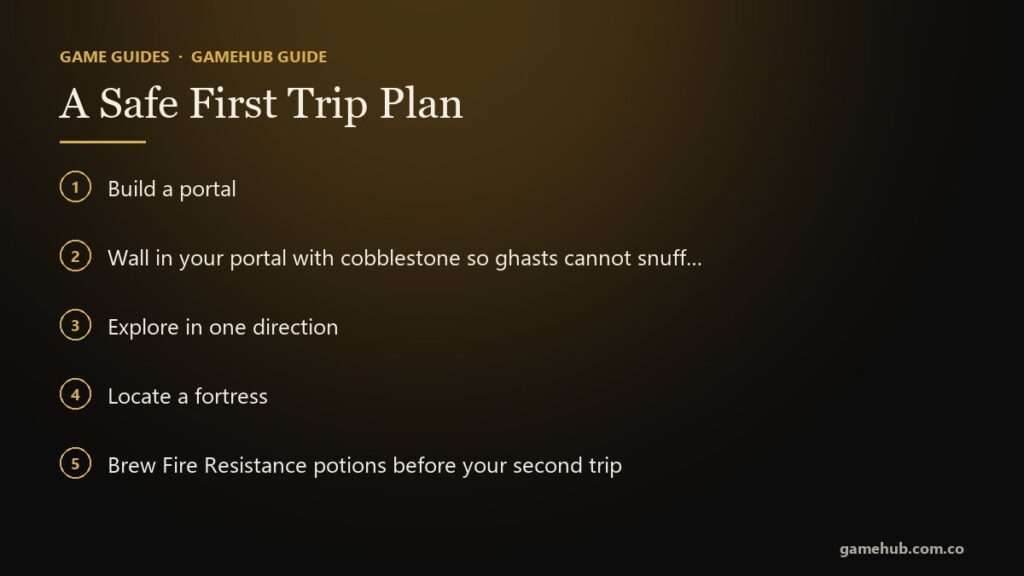
- Build a portal, step through, and immediately note your Nether coordinates.
- Wall in your portal with cobblestone so ghasts cannot snuff it out.
- Explore in one direction, placing torches or blocks on one side of your path so you can find your way back.
- Locate a fortress, collect a few blaze rods and some Nether Wart, then go home.
- Brew Fire Resistance potions before your second trip, when you go looking for bastions and Ancient Debris.
For more PS5-specific Minecraft help, browse our Minecraft on PS5 hub.
Frequently Asked Questions
How much obsidian do I need for a Nether portal?
Ten blocks is the minimum. The smallest portal is 4 wide and 5 tall, and the four corners do not need obsidian.
Why do piglins attack me when I am wearing gold?
You probably opened a chest, broke a container or gold block, or hit a piglin nearby. Piglin brutes also ignore gold armor completely and always attack.
What is the best Y level for Ancient Debris on Bedrock?
Around Y 16. Most Ancient Debris on Bedrock generates between Y 8 and Y 23, with the highest average at Y 16.
Can I set my spawn point in the Nether?
Yes, with a charged Respawn Anchor. Beds explode if you use them in the Nether.
Where do I find blaze rods?
Blazes spawn in Nether Fortresses, often around blaze spawners. Bring a bow, snowballs or a shield, and fight them from cover to avoid their fireballs.
Final Verdict
The Nether punishes rushing more than anything else. Go in with gold armor, cobblestone, Flint and Steel and a plan, note your coordinates, and treat every lava pool and open cliff with care. Your first goal is a fortress for blaze rods and Nether Wart. After that, bastions and Ancient Debris at around Y 16 turn diamond gear into netherite. Take it one trip at a time and the most dangerous dimension in Minecraft becomes one of the most rewarding.
Sources & References
- Minecraft Wiki: The Nether – height, lava level, biomes, beds, water and Bedrock map behaviour.
- Minecraft Wiki: Nether Portal – frame size, coordinate conversion and Bedrock’s portal search radius.
- Minecraft Wiki: Piglin – gold armor rule and what angers piglins on Bedrock.
- Minecraft Wiki: Piglin Brute – hostility, health and spawning.
- Minecraft Wiki: Bartering – barter items and Bedrock timing differences.
- Minecraft Wiki: Hoglin – health, spawning and what hoglins avoid.
- Minecraft Wiki: Nether Fortress – Bedrock mob spawning rules, Nether Wart and chest loot.
- Minecraft Wiki: Wither Skeleton – Wither effect, height and Bedrock skull drop chances.
- Minecraft Wiki: Ancient Debris – Bedrock generation heights and blast resistance.
- Minecraft Wiki: Netherite Upgrade – template locations and duplication recipe.
Minecraft receives regular updates that can change mobs, structures and loot, so details here may differ in future versions. Minecraft is a trademark of Mojang Studios and Microsoft. GameHub is not affiliated with or endorsed by Mojang Studios or Microsoft.