An enchanted diamond pickaxe mines faster, lasts longer and pulls extra loot out of every ore, and the difference between a random enchant and a planned one is huge. Enchanting in Minecraft looks like a lottery at first, but once you understand bookshelves, lapis, anvils and which enchantments clash, you can build exactly the gear you want. This guide covers how enchanting works on Bedrock Edition (the version on PS5) and lists the best enchantments for every tool, weapon and armor piece.
Enchanting at a Glance
| Topic | Key facts (Bedrock) |
|---|---|
| Enchanting Table recipe | 1 Book, 2 Diamonds, 4 Obsidian |
| Bookshelves for max power | 15, with one block of air between them and the table |
| Highest table level | 30 |
| Cost of each option | 1, 2 or 3 Lapis Lazuli and the same number of levels |
| Anvil limit | Any job costing 40 levels or more shows “Too Expensive!” |
| Removing enchantments | Grindstone (curses stay, some XP is returned) |
| Best all-round enchantments | Unbreaking III and Mending on everything you plan to keep |
| Not available from the table | Mending, Frost Walker, Soul Speed, Swift Sneak, Wind Burst and curses |
How the Enchanting Table Works
Craft an Enchanting Table from one book, two diamonds and four obsidian. Place an item and Lapis Lazuli in the table, and it shows three options. Each option needs a minimum experience level and costs 1, 2 or 3 Lapis Lazuli. The number of levels actually taken from you matches the lapis cost, so the bottom option might require level 30 but only removes 3 levels and 3 lapis.
On Bedrock, hovering over an option shows one enchantment it will apply. That is only a hint: the final item can come out with extra enchantments on top. The strange symbols next to each option are purely decorative and mean nothing.
Setting up 15 bookshelves
Without bookshelves, the table only offers weak, low-level enchantments. To unlock level 30 offers you need 15 bookshelves placed around the table with a one-block gap of air between the shelves and the table. The usual layout is a ring of shelves two blocks out from the table, at the same height as the table or one block higher, with a gap left for you to walk in. A solid block in that gap stops the shelf behind it from counting, so keep the ring of air clear and light the room with lanterns or torches placed on the outside of the shelves.
Each bookshelf takes six planks and three books, and each book needs three paper and one leather. That is 45 books for a full setup, so a sugar cane farm and a few cows make life much easier. Librarian villagers also sell bookshelves if you have emeralds to spare.
Why you should enchant at level 30
The bottom slot at level 30 gives you the best chance of top-tier enchantments such as Efficiency IV or Protection IV, and sometimes several at once. Because it only costs 3 levels, you can usually enchant again soon after. A good habit is to save up to 30 levels before visiting the table, take the bottom option, and repeat.
Enchanting books
You can also put a plain book into the table. It turns into an enchanted book that you can apply later with an anvil. This is useful when the table keeps offering something you do not want on your sword but would like on another item.
Anvils: Combining and Upgrading
The anvil is where you turn random enchants into a planned build. Put the item you want to keep in the first slot and an enchanted book (or a second item of the same type) in the second. Duplicate enchantments of the same level combine into the next level up, so two Sharpness III books make Sharpness IV. Conflicting enchantments from the second item are dropped.
Avoiding “Too Expensive!”
Every time an item goes through an anvil, it picks up a prior work penalty that makes the next job more expensive. The penalty grows quickly: 0, 1, 3, 7, 15, 31 levels after each use. Any job that would cost 40 levels or more is refused with “Too Expensive!”, even if you have the levels. A few rules keep costs down:
- Combine books first. Merge your books into one or two books, then apply them to the item, so the item itself goes through the anvil as few times as possible.
- Apply the most valuable enchantments early, before the penalty builds up.
- Order matters. Swapping which item goes in the first and second slot can change the cost a lot, so check both ways.
- Renaming costs 1 level plus any existing penalty but does not add to the penalty itself.
One handy Bedrock difference: when you upgrade an enchantment, Bedrock charges only for the level increase, while Java charges for the final level. Upgrades are often cheaper on PS5 than Java guides suggest.
Repairing on an anvil
Each unit of the item’s base material (for example, a diamond for diamond gear) restores up to 25% durability for 1 level plus the prior work penalty. Wait until an item is badly damaged and use four units at once to get full value. Anvils also wear down: each use has a 12% chance to damage the anvil, which eventually breaks.
Grindstone and Mending
A grindstone strips every enchantment except curses from an item or book and gives back a small amount of experience. Use it to clean up a bad roll before re-enchanting, or to free a book from a junk enchantment.
Mending is the most important enchantment in the game for long-term gear. While you hold or wear a damaged Mending item, experience orbs you pick up repair it at 2 durability per experience point instead of adding to your level. If several items need repairs, the game picks one at random per orb. Mending cannot come from the table; get it from librarian villagers, fishing, chest loot, or, on Bedrock only, as a raid drop.
Enchantments That Do Not Mix
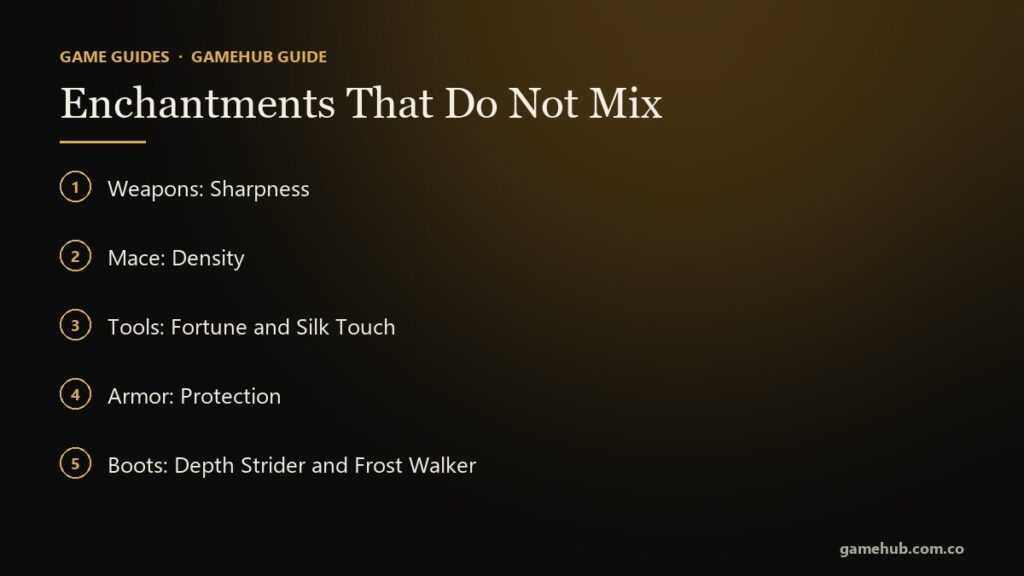
Some enchantments are mutually exclusive, so you have to choose one from each group:
- Weapons: Sharpness, Smite and Bane of Arthropods
- Mace: Density, Breach, Smite and Bane of Arthropods
- Tools: Fortune and Silk Touch
- Armor: Protection, Fire Protection, Blast Protection and Projectile Protection
- Boots: Depth Strider and Frost Walker
- Bow: Infinity and Mending
- Crossbow: Multishot and Piercing
- Trident: Riptide cannot go with Loyalty or Channeling
Best Enchantments for Every Tool
| Item | Recommended enchantments | Notes |
|---|---|---|
| Pickaxe | Efficiency V, Unbreaking III, Mending, Fortune III | Keep a second Silk Touch pickaxe |
| Axe | Efficiency V, Unbreaking III, Mending, Sharpness V | Bedrock tables can offer Sharpness on axes |
| Shovel | Efficiency V, Unbreaking III, Mending, Silk Touch | Silk Touch collects grass and mycelium blocks |
| Hoe | Efficiency V, Unbreaking III, Mending, Fortune III | Hoes break leaves fast; Fortune raises sapling drops |
| Sword | Sharpness V, Looting III, Fire Aspect II, Unbreaking III, Mending | Sweeping Edge is Java only |
| Bow | Power V, Unbreaking III, Flame, Punch II, plus Infinity or Mending | Infinity still needs one arrow in your inventory |
| Crossbow | Quick Charge III, Multishot or Piercing IV, Unbreaking III, Mending | Multishot is better for groups |
| Trident | Loyalty III, Impaling V, Channeling, Unbreaking III, Mending | Or Riptide III for travel in water and rain |
| Mace | Density V or Breach IV, Wind Burst III, Unbreaking III, Mending | Wind Burst only comes from ominous vaults |
| Spear | Sharpness V, Lunge III, Unbreaking III, Mending | Lunge pushes you forward on a jab |
| Fishing Rod | Luck of the Sea III, Lure III, Unbreaking III, Mending | Fishing is also a source of Mending books |
| Shears, Shield, Elytra | Unbreaking III, Mending | Bedrock shears can take Silk Touch too |
Pickaxe: Fortune or Silk Touch?
Fortune III increases drops from ores such as coal, lapis, redstone, emerald and diamond, so it is the better everyday choice. Silk Touch mines the block itself: glass, ice, bookshelves, ores you want to store and smelt later, and blocks like grass that otherwise turn into dirt. Since they cannot share a tool, most players carry one of each. If you are still hunting for your first diamonds, see our Minecraft on PS5 hub for guides on the early game.
Sword and axe
Sharpness V is the default damage upgrade. Smite only helps against undead mobs and Bane of Arthropods against spiders and similar mobs, so they are niche choices. Looting III increases mob drops, and on Bedrock it raises the wither skeleton skull drop chance by 2% per level instead of Java’s 1%. Fire Aspect sets targets on fire but also cooks animal drops, which some players prefer. Because Bedrock tables offer Sharpness on axes, a strong axe can double as a weapon.
Trident: a Bedrock advantage
On Bedrock, Impaling deals extra damage to any mob that is in water or standing in rain, not just ocean mobs as on Java. That makes an Impaling V trident a genuinely strong weapon during storms on PS5. Loyalty brings the trident back after you throw it, while Riptide launches you through water or rain instead. Channeling summons lightning on a target during a thunderstorm.
Best Enchantments for Armor
| Armor piece | Recommended enchantments |
|---|---|
| Helmet | Protection IV, Respiration III, Aqua Affinity, Unbreaking III, Mending |
| Chestplate | Protection IV, Unbreaking III, Mending |
| Leggings | Protection IV, Swift Sneak III, Unbreaking III, Mending |
| Boots | Protection IV, Feather Falling IV, Depth Strider III, Soul Speed III, Unbreaking III, Mending |
Protection IV on every piece gives the best general damage reduction. Fire Protection or Blast Protection on one or two pieces can help for the Nether or for fighting creepers, but you cannot combine them with regular Protection on the same piece. Feather Falling IV is the single most life-saving boot enchantment. Thorns is optional: it damages attackers but costs extra durability. On Bedrock, the table can put Thorns on helmets, leggings and boots, not only chestplates.
Swift Sneak (faster movement while crouching) is only found in Ancient City chests, and Soul Speed (faster on soul sand and soul soil) comes from Bastion Remnant chests and piglin bartering. Neither can come from the table or librarians, so add them with an anvil when you find them.
Treasure Enchantments and Where to Find Them
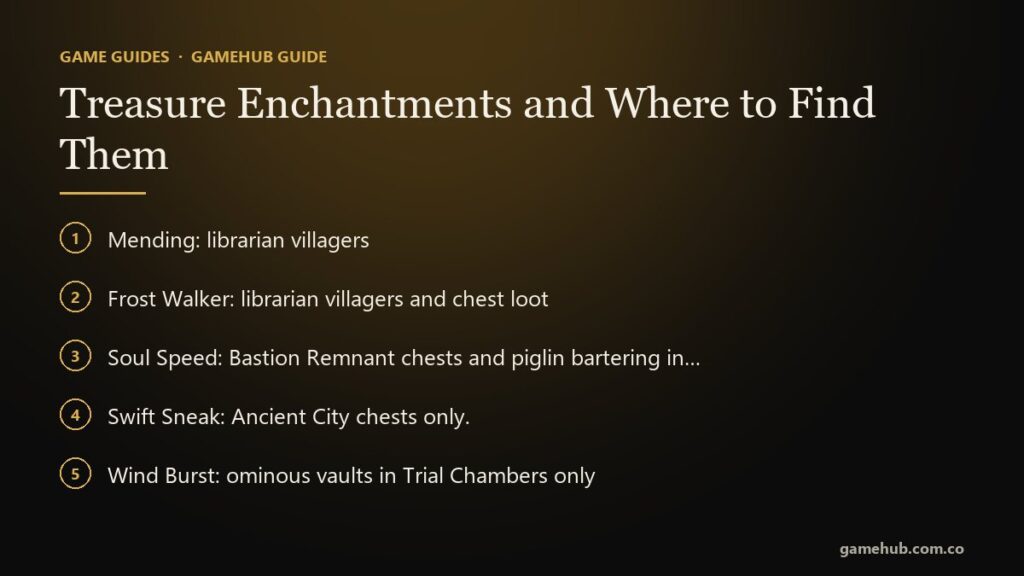
- Mending: librarian villagers, fishing, chest loot and, on Bedrock, raid drops.
- Frost Walker: librarian villagers and chest loot. It freezes water under your feet.
- Soul Speed: Bastion Remnant chests and piglin bartering in the Nether.
- Swift Sneak: Ancient City chests only.
- Wind Burst: ominous vaults in Trial Chambers only, for the mace.
- Curse of Binding and Curse of Vanishing: unwanted extras found on loot. A grindstone cannot remove them.
Where to Get the Experience
Enchanting and anvils both run on experience levels. Good early sources include mining coal, redstone, lapis and quartz, smelting items in a furnace, breeding animals, trading with villagers, and fighting mobs at night. Building a safe mob farm needs some basic redstone knowledge, but even a simple dark room that funnels mobs to one spot can get you to level 30 quickly.
Frequently Asked Questions
How many bookshelves do I need for level 30 enchantments?
Fifteen. Place them around the table with exactly one block of air between the shelves and the table, at the same height as the table or one block above it.
Why does the anvil say “Too Expensive!”?
The job would cost 40 or more levels, usually because the item has been through the anvil many times. Plan your combinations in advance, merge books first, and avoid repeatedly adding single enchantments to the same item.
Can I get Mending from the enchanting table?
No. Mending is a treasure enchantment. Get it from librarian villagers, fishing, chests or raid drops on Bedrock, then apply it with an anvil.
Can I have Infinity and Mending on the same bow?
No, they are mutually exclusive. Infinity saves arrows, while Mending keeps the bow repaired. If you use a bow a lot, Mending is the better long-term choice.
Does enchanting cost all 30 levels?
No. You need 30 levels to pick the bottom option, but it only takes 3 levels and 3 Lapis Lazuli. The top and middle options cost 1 and 2 levels.
How do I remove a bad enchantment?
Put the item in a grindstone. It removes every enchantment except curses and returns a little experience, so you can re-enchant the item from scratch.
Final Verdict
Enchanting rewards patience more than luck. Build your 15-bookshelf setup, always enchant at level 30, and use the anvil to stack books in a sensible order so you never hit the “Too Expensive!” wall. Put Unbreaking III and Mending on anything you plan to keep, choose Fortune or Silk Touch per pickaxe, and take advantage of Bedrock perks such as Sharpness axes and rain-boosted Impaling tridents. With those habits, your PS5 world will be full of gear that lasts forever. New to the game? Our list of the best PS5 games for beginners explains why Minecraft is one of the easiest places to start.
Sources & References
- Minecraft Wiki: Enchanting Table – recipe, bookshelf requirement, lapis and level costs on Bedrock.
- Minecraft Wiki: Enchanting – incompatible enchantments, treasure enchantments and Bedrock vs Java differences.
- Minecraft Wiki: Anvil Mechanics – prior work penalty, “Too Expensive!” limit, repair costs and anvil damage.
- Minecraft Wiki: Mending – repair rate, item selection and Bedrock raid drops.
- Minecraft Wiki: Swift Sneak – Ancient City source and speed values.
- Minecraft Wiki: Wind Burst – ominous vault source and mace use.
- Minecraft Wiki: Lunge – spear enchantment effect and maximum level.
- Minecraft Wiki: Wither Skeleton – Bedrock Looting bonus to skull drops.
Minecraft receives regular updates that can change enchantments, costs and loot sources, so details here may differ in future versions. Minecraft is a trademark of Mojang Studios and Microsoft. GameHub is not affiliated with or endorsed by Mojang Studios or Microsoft.